Multi-market platform design, at the design lead level.
Lead product designer on Mapfre Internacional's digital platform work: Verti brand redesign across Italy and Germany, an Insurance Offices & Agents Directory deployed across Latin America, and a CRO programme for international digital properties. All in English, across multiple markets and a shared development partner.


A separate account, a different kind of complexity
The Mapfre engagement at Flat 101 covered two legally distinct entities. Mapfre España, which included the AFIN financial app, operated independently from Mapfre Internacional, which managed the Verti direct insurance brand across European markets and digital properties across international territories. Both accounts ran in parallel at Flat 101, but with entirely different client teams, technical stacks, and design needs.
The Internacional work was conducted entirely in English, with Capgemini as the shared development partner across all programmes. Complexity wasn't just about the number of markets; it was about managing multi-agency delivery across teams that each operated under different organisational cultures and timelines.
Two markets, one convergence approach
Verti is Mapfre's direct insurance brand, operating in Italy, Germany, and Spain. The platforms had evolved independently per market, accumulating inconsistencies in UX patterns, design system components, and conversion flows. Some differences were intentional (regulatory or cultural requirements), but most were simply the result of independent development without shared standards.
The engagement began with Verti Italia: a full platform redesign migrating from a custom-built platform to the Mapfre corporate design system, while preserving Verti's distinct branding and adapting to Italian regulatory requirements. Verti Germany followed as a sequential project: same methodology, same design system foundation, applied to Germany-specific requirements, brand criteria, and technical constraints. My role on both was design lead, directly supervising two designers throughout the engagement. Daily responsibilities included client requirements alignment, progress presentations with the Mapfre and Capgemini teams, work plan definition and phase management, and maintaining coherence between the Mapfre corporate system and Verti's own branding.
Shared structure, localized surface
Before any redesign, most of the audit work was figuring out which cross-market differences were actually intentional (regulatory requirements, local conventions, deliberate brand calls) and which had just accumulated because each market had built independently for years with no shared standard to check against. Those two categories needed completely different fixes, and mixing them up would have meant either breaking something a market needed or preserving an accident as if it were policy.
The shared design system became the operational foundation: components, interaction patterns, and conversion flows consistent across markets, defined once and adapted at the surface layer. For a brand like Verti, which has its own strong branding within the Mapfre family, this required careful work at the boundary between the Mapfre corporate system and Verti's own aesthetic. The goal was not uniformity; it was coherence without flattening the brand.

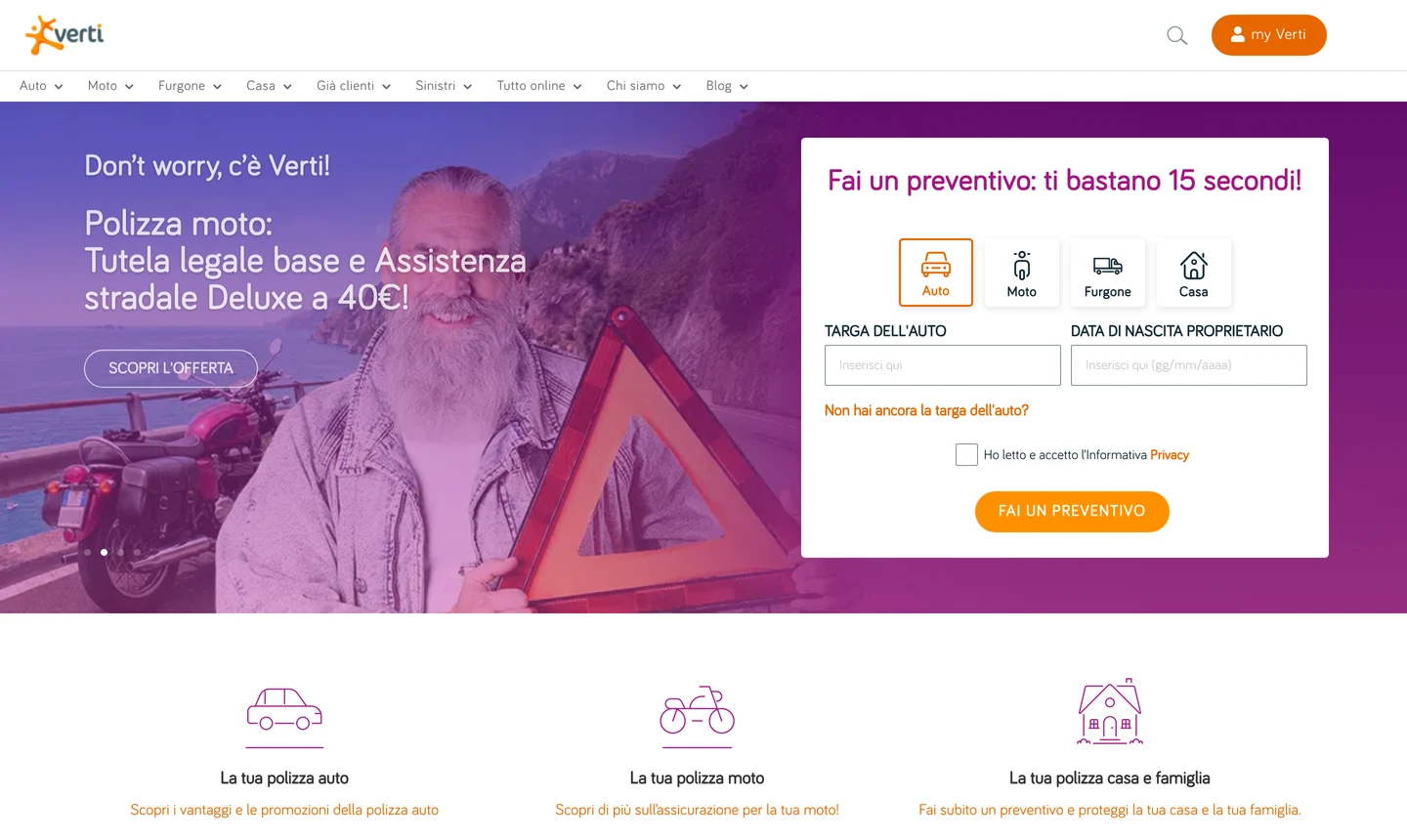
Verti Italia, Self-service funnel. The first step of the prospecting flow, redesigned as part of the Verti platform convergence: policy type, vehicle details, and CTA in a single, uncluttered entry point.
A public-facing feature for international markets
Alongside the Verti platform work, I designed a public-facing product feature for Mapfre Internacional: an Insurance Offices & Agents Directory enabling users to find nearby Mapfre offices and registered insurance agents. The feature comprised three interconnected components: an interactive map, a filterable directory listing, and individual profile pages per office and per agent.
Initial deployment covered Brazil, Peru, and Nicaragua, with a structured rollout to additional markets underway at the point of handover. Multi-market deployment required careful consideration of localisation beyond language: address format conventions, map provider integration per territory, regulatory requirements for displaying licensed agent information in each country, and country-specific page structures for local compliance.
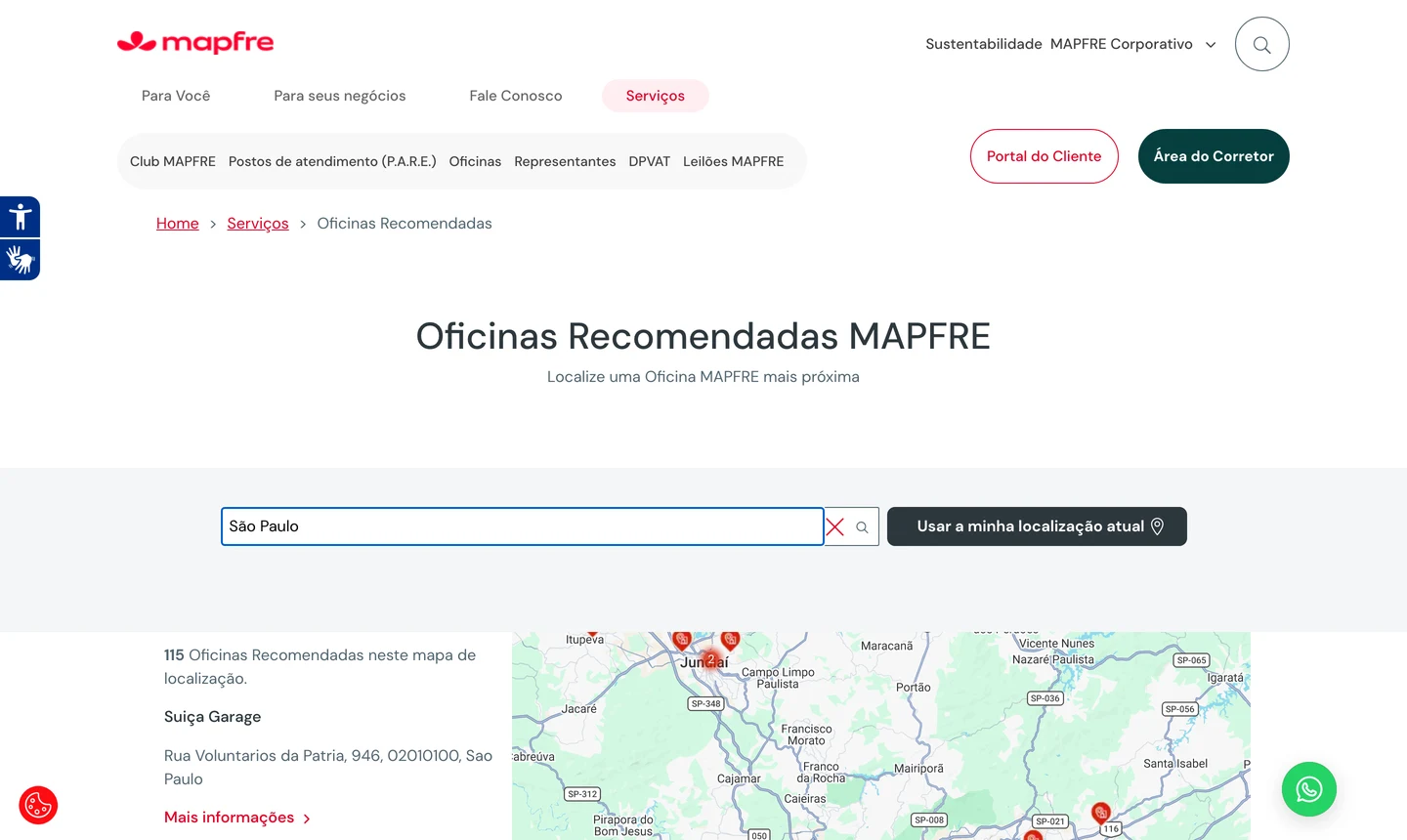
Insurance Offices Directory, Brazil. Interactive map with clustered markers across São Paulo. Filterable directory, office listings, and individual agent profile pages, deployed across Brazil, Peru, and Nicaragua.
Experiment design for international properties
A conversion rate optimisation programme ran alongside the platform redesign work, applying structured hypothesis development and experiment design to Mapfre Internacional's digital properties. The work covered the full CRO pipeline: data analysis to surface friction points, hypothesis formulation, design of test variants, implementation specification, and results analysis.
Performance data and programme scope for this engagement are subject to NDA and have not been published by the client.
Running three programmes from the lead role
Running concurrent programmes for the same client required clear workload management across the team. For the Verti work specifically, leading two designers meant defining task scope and priorities, reviewing output quality and brand coherence, and handling all client-facing presentations and requirements alignment. Work plans, phase definitions, and effort estimates were mine to define and maintain.
Daily communication with the Mapfre teams and Capgemini in English, across multiple markets and time zones, required documentation and status management rigorous enough that all parties stayed aligned without constant synchronisation. In a multi-agency environment, the cost of miscommunication lands on the design team first, and fast feedback loops between design, development, and client are the only effective mitigation.
What multi-market platform work teaches you
The most useful distinction in multi-market design is between divergence that serves the user and divergence that serves no one. Platforms that evolve independently tend to accumulate a lot of the second kind: inconsistencies that developed because nobody was watching, not because the local market required them. Finding and removing that accidental drift is its own design discipline, and it's usually where the biggest efficiency gains are sitting, waiting for someone to notice them.
Leading design across several concurrent programmes, each with its own team, timeline, and level of client readiness, taught me something about what the lead role is actually for. Quality control is the easy part. The harder part is keeping one coherent picture of the whole engagement in your head when every individual programme has a natural pull toward becoming its own silo.
Specific performance data for this engagement is subject to NDA.
Your hardest problem
is a good place to start.
Open to senior product design roles and selective consulting engagements, in English or Spanish.