Optimising loyalty under tight constraints.
Project lead for ongoing conversion optimisation across the IQOS Club members' portal: fast-cycle experimentation, behavioral economics applied to habit and retention mechanics, operating under limited traffic and shared resources.
A loyalty programme with a specific kind of complexity
IQOS Club is Philip Morris International's loyalty programme for IQOS users in Spain, a members' portal where users track rewards, access exclusive content, manage their devices, and engage with the brand between purchases. The programme sits in the tobacco alternatives category, which carries significant marketing restrictions and shapes what's possible in digital promotion.
Acquisition wasn't really the CRO challenge here. Engagement and retention were: getting existing members to use the platform more, move up through loyalty tiers, and stay connected to the brand over the long haul. That calls for a different set of levers than a standard transactional funnel.
Low traffic, high standards
Loyalty portals are structurally harder to optimise than transactional funnels. Traffic volumes are lower, because you're targeting only existing members, not the broader market. This means experiments take longer to reach statistical significance, and the risk of acting on false positives is higher.
In this environment, good CRO practice requires more discipline, not less. The hypothesis quality has to be higher because you can run fewer experiments. The design decisions have to be better informed because you have less data to course-correct with.
Behavioral economics in a loyalty context
The most relevant behavioral frameworks for loyalty are different from those that dominate conversion optimisation in e-commerce. Loss aversion still applies: the framing of tier status and expiring points is a powerful lever. But habit formation mechanics become more important here: variable reward schedules, completion mechanics, progress visualisation.
As project lead, I was responsible for generating the experiment pipeline: identifying opportunity areas through analytics and heuristic review, structuring hypotheses, prioritising based on potential impact and implementation cost, and communicating the programme's direction to the client. The design work included experiment variant design, interaction specifications, and performance analysis.
The experiment pipeline ran in three phases: insight generation (web analytics, heatmaps, heuristic review, and behavioral economics framing), hypothesis and prioritisation (structuring focused hypotheses ranked by impact versus implementation cost), and rapid experimentation using Visual Website Optimizer (VWO). VWO enabled both A/B tests and personalisation variants without heavy development overhead, a key constraint given the shared-resource model. Personalisation complemented A/B work: tailoring content and mechanics to member segments, rather than forcing a single optimised experience on a heterogeneous membership base.
"In loyalty work, 'will people convert' is the easy question. The one that actually matters is whether you're building a habit or just catching them in a good mood."
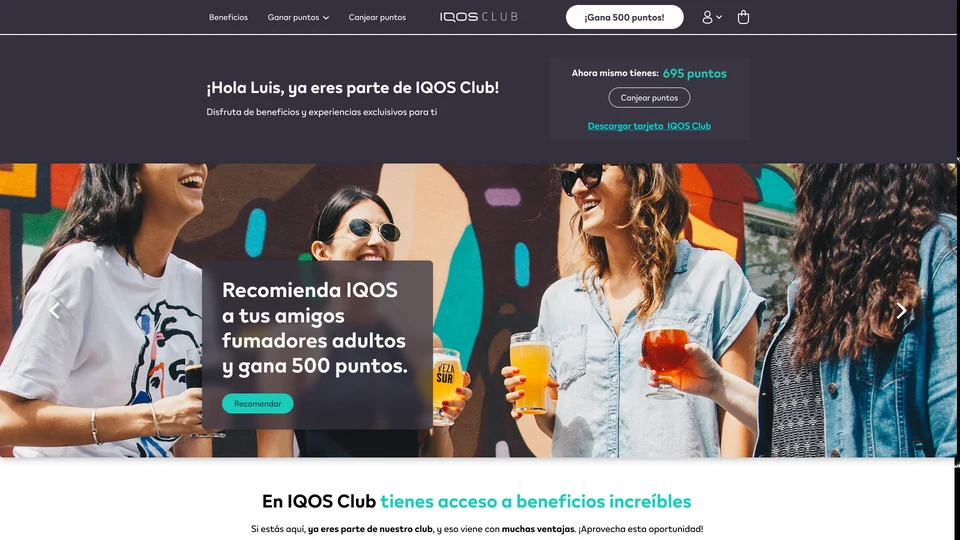
Homepage: Referral programme entry point. V6 replaced the default hero with a full-bleed lifestyle photo tied to the active referral campaign, making the referral CTA the primary visual focus. Hypothesis: a contextually relevant, campaign-led hero outperforms the default brand hero at driving referral programme engagement.


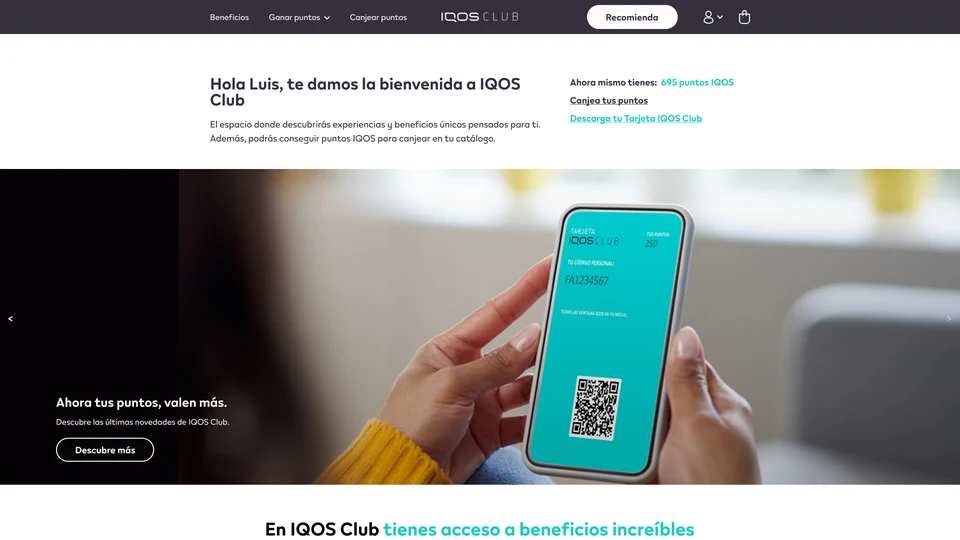
Recomienda: Reward framing test. The control offered 1,000 points buried in a cluttered layout. V1 reduced the reward to 500 points but redesigned the page with cleaner hierarchy and a more prominent CTA, testing whether a better-framed lower reward could outperform a higher reward presented poorly.


Personalisation: Segment-led homepage CTA. Members with 2,500+ points see a "Canjear puntos" primary CTA, the natural next step for a high-balance member. Members below 500 points see earn-oriented CTAs with a teal notification bar surfacing relevant actions. Same hero; different primary intent.
Ongoing programme with measurable engagement gains
The IQOS Club engagement improved across the programme period. Specific figures are subject to client confidentiality and have not been published. The programme ran continuously throughout the Flat 101 engagement.
The more durable outcome for me was methodological: running CRO at low traffic volumes sharpens your thinking about what makes a good hypothesis and what constitutes meaningful evidence. The discipline of making high-quality decisions with limited data is transferable to almost any design context.
CRO tooling as a campaign delivery channel
As the programme matured, something useful happened: the client began recognising VWO not just as a testing tool, but as a fast deployment channel for time-sensitive campaign assets. Because VWO variants could go live without a development sprint, it became the preferred path for promotional modals, campaign banners, and temporary content tied to specific launches.
This was a natural evolution. The same infrastructure that let us test UX hypotheses could push a promotional overlay to logged-in members within hours of a product launch, without touching the underlying platform. Promotional modals for device releases and loyalty campaigns became a recurring deliverable alongside the A/B pipeline.

Promotional modal: IQOS ILUMA Stardrift launch. One of several campaign modals deployed via VWO during the programme. Triggered on login for targeted member segments, timed to product availability windows. Designed, built, and deployed without a development sprint.
Your hardest problem
is a good place to start.
Open to senior product design roles and selective consulting engagements, in English or Spanish.